Types of Trademarks: Goods, Services, and the Weird Stuff
In the eyes of the USPTO, not all brands are created equal. The government puts your trademark into one of several buckets depending on what you are selling.
If you put yourself in the wrong bucket, your application will be rejected. You can’t use a Service Mark specimen for a physical good. You can’t file a Certification Mark just because you think it sounds cool.
Here are the five types of marks you need to know:
- Trademarks (The Goods)
- What it is: A brand name or logo used for physical goods.
- Examples: Nike (Shoes), Coca-Cola (Soda), Apple (iPhones).
- The Specimen Rule: You must show the mark on the product itself (a label, a tag, or the packaging) or at the point of sale.
- The Symbol: Uses ™ while pending, ® when registered.
- Service Marks (The Invisible Product)
- What it is: A brand name or logo used for services (where no physical product changes hands).
- Examples: Geek Squad (Repair), Jiffy Lube (Oil Change), Trademark Vault (Legal Services).
- The Specimen Rule: You can’t tag a service. So, you show the mark on advertising (websites, brochures, signage).
- The Symbol: Technically uses ℠ while pending, but most people just use ™ because it’s easier. Uses ® when registered.
- Trade Dress (The Look and Feel)
- What it is: The visual appearance of a product or its packaging that is so unique, customers recognize it without reading the name.
- Examples:
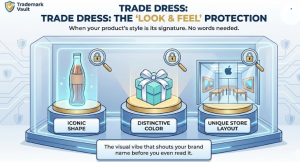
* The shape of a **Coca-Cola bottle**.
* The **Tiffany Blue** box.
* The layout of an **Apple Store**.
- The Catch: It is difficult to get. You have to prove that customers see the shape/color and immediately think of YOU. You usually can’t get this until you’ve been in business for 5+ years.
- Certification Marks (The Stamp of Approval)
- What it is: A mark that proves a product meets a certain standard of quality, origin, or accuracy. Crucial Rule: The owner of the mark cannot sell the products. They only certify others.
- Examples: Energy Star, Fair Trade, Woolmark.
- Note: Clients often ask us, “I want to trademark a seal for my coaching program called ‘Certified Master’.” Unless you are running an independent testing body, this is usually the wrong path. You probably just want a regular trademark.
- Collective Marks (The Club)
- What it is: A mark used by members of a group to show they belong to an organization.
- Examples: CPA (Certified Public Accountant), Girl Scouts (on cookies), FTD Florists.
- The Function: It tells the consumer, “I am a member of this trusted club.”
The TL; DR Summary
Trademarks identify the source of physical goods. Service marks identify the source of provided services. Non-traditional trademarks protect unique sounds, colors, scents, and 3D shapes. Trade dress protects the distinct visual appearance or packaging of a product.
Key Takeaways
- Goods vs. Services: This is the #1 distinction. Get it wrong, and your specimen will be rejected.
- Trade Dress is Hard.